
Imagine someone who lives in a neighborhood that is poor and economically underdeveloped. Jobs are scarce, and life is very unpredictable. Do you think this person is going to plan for the future? How aggressive might this person be?
THE NATURE OF STEREOTYPES
Many of us hold stereotypes—beliefs about how people from different groups are generally like. Often, we talk about stereotypes such as those of race, gender, and age. But how about ecology stereotypes—stereotypes about others based on the environments they live in?
We find that people DO hold ecology stereotypes. Specifically, people believe that individuals who live in environments like the one you just imagined (referred to as “harsh” environments) are more impulsive, aggressive, and oriented towards short-term relationships.
The implications of ecology stereotypes run deep. One of the oldest questions in social psychology is: why do we have race stereotypes? It turns out that certain race stereotypes may actually be, fundamentally, ecology stereotypes.
When we ask people about their stereotypes of Blacks and Whites in the U.S., Blacks are stereotyped to be more aggressive and impulsive than Whites. However, we then ask people to think about a Black or White person who live in different ecologies, like these ones below…


When people are asked to think about a Black or White person who both live in a developed neighborhood, where jobs are available and life is very predictable (left photo), the race stereotype disappears. Both the Black and White person living in this environment are seen as equally planful and not aggressive. On the other hand, the Black and White individuals who live in the less developed neighborhood where life is unpredictable (right photo) are both seen as more impulsive and aggressive, and similarly so.
For a summary of the research, see this. In recent work, we find that ecology stereotypes may be universal—people in other societies, including Japan, India, the U.K., and Romania also hold ecology stereotypes.
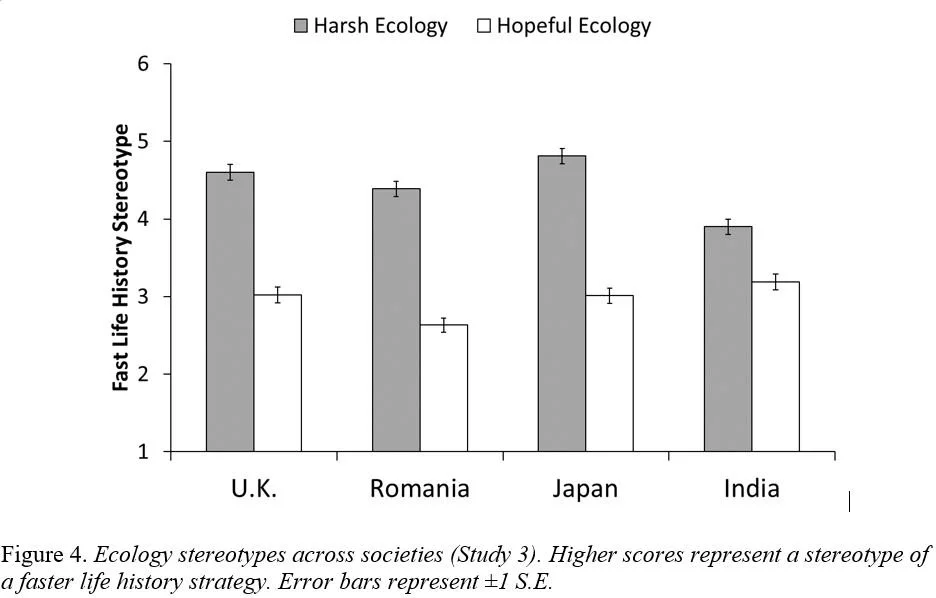
That ecology stereotypes exist in other societies has interesting implications. In Japan, it seems that people think single-mother families live in harsh environments. Consequently, people also think a child who grew up with a single mother is more impulsive and aggressive than a child who grew up with both parents. But when people are now asked to think about these two children, but both live in a harsh (or not) environment, the family stereotype disappears. Just like how the race stereotype disappeared in the U.S.
Are there other kinds of stereotypes, beyond race and family, than might really be ecology stereotypes? This is something we are interested in exploring further.